
AGES 7-9
NUMBER OF TITLES IN LIVING SKILLS:
29 (27 book titles are currently available)
BASIC PREMISE OF LIVING SKILLS:
Children are often ill equipped to assume the responsibilities that are required of them. Failure to perform adequately creates frustrations and disappointments for children and the people around them.
The purpose of the LIVING SKILLS products is to teach children the information and skills they need to live intelligently and responsibly. This is accomplished by teaching children the personal skills they need to take care of themselves, the social skills they need to develop and maintain positive relationships, and the coping skills they need to relate to things in positive rather than negative ways.
The LIVING SKILLS products are considered to be the heart of Joy Berry’s core product line as the three core products that precede LIVING SKILLS prepare children to learn the Basic Living Skills taught via the LIVING SKILLS materials. In addition, the two core products that follow LIVING SKILLS build upon the Basic Living Skills taught via the LIVINGS SKILLS materials.
DEVELOPMENTAL ORGANIZATION OF LIVING SKILLS:
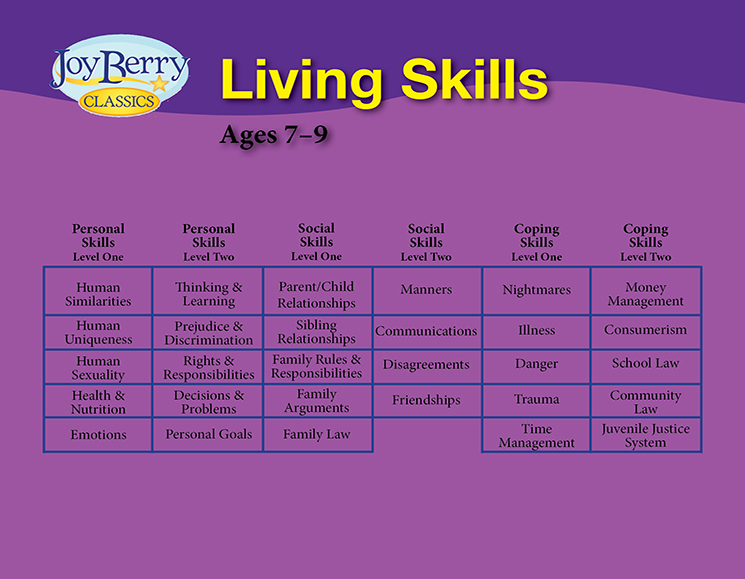
Given every child’s normal developmental progression from being egocentric to being social to caring about the things that surround them, it is recommended that the LIVING SKILLS subjects be presented in the following developmental sequence:
GUIDELINES FOR USING LIVING SKILLS:
In order to derive the maximum benefits from the LIVING SKILLS books it is recommended that adults use them in the following ways:
Phase One - Adult Resource: The adult reads the books for information, insights, and encouragement.
Phase Two – Adult-Child Activity: The adult uses the materials with the child and encourages the child to question or comment on the subject matter.
Phase Three - Independent Activity: The child is encouraged to use the materials independently of the adult for entertainment and to reinforce the subject matter.
Phase Four - Reference Material: The materials are placed in the child’s library along with other resource materials and used whenever specific situations need to be addressed.
To insure the success of the skills that are being taught via the self-help books it is recommended that the “show-me-how-then-let-me-do-it” teaching method be used.
Step One The adult demonstrates how the task should be done by doing it while the child watches.
Step Two The adult does the task with the child or watches while the child does the task. (The adult should avoid criticizing, and instead should praise anything the child does correctly.)
Step Three The adult allows the child to do the task alone.
Step Four The adult praises the work and expresses appreciation for what the child has done.
DESCRIPTIONS OF LIVING SKILLS SUBJECTS:
Human Similarities explains the ways in which every person is like other people and encourages children to find comfort in the similarities.
Human Uniqueness explains the ways in which every person is unique and encourages children to value and accept themselves.
Human Sexuality compares sexual identity with sexual roles and encourages children to exploit their full potential regardless of their sexual identities.
Health and Nutrition explains the importance of, and guidelines for, good nutrition, exercise, cleanliness, and rest and encourages children to take care of their bodies.
Emotions explains how feelings can influence a person positively or negatively and encourages children to handle their feelings appropriately.
Thinking and Learning teaches the intellectual skills that can help children become lifelong learners.
Prejudice and Discrimination explains the harmful effects of prejudice and discrimination and teaches children how to form opinions intelligently.
Rights and Responsibilities defines the basic rights to which all humans are entitled, and explains the responsibilities that go along with human rights.
Decisions and Problems teaches how to make intelligent decisions and how to resolve problems in positive ways.
Personal Goals teaches children how to establish and attain their personal goals.
Parent/Child Relationships explains the challenges of being a parent and encourages children to respect and appreciate their parents.
Sibling Relationships explains sibling rivalry and teaches children how to get along with their brothers and sisters.
Family Rules and Responsibilities encourages children to help establish and maintain the family rules and regulations.
Family Arguments explains the causes of family arguments and teaches how to handle them in positive ways.
Family Law explains the legal rights and responsibilities of parents and their children.
Manners explains why good manners are important and teaches children how to behave graciously in the various situations they encounter.
Communication explains the various ways people communicate and teaches children how to communicate honestly, accurately, and effectively.
Disagreements explains how conflicts develop and teaches children positive ways to resolve them.
Friendships explains why friends are important and teaches how to develop and maintain friendships.
Nightmares teaches children about good and bad dreams and explains how to handle nightmares.
Illness teaches how to prevent illness and what children can do to help facilitate their recovery when they are sick.
Danger teaches children how to protect themselves from dangerous people, objects, places, and situations.
Trauma defines trauma and its causes and teaches children how to handle it in constructive ways.
Time Management teaches children how to organize their time in order to accomplish the things they need and want to do.
Money Management provides a variety of ways children can earn money, and teaches how to handle money appropriately.
Consumerism teaches children how to be intelligent consumers.
School Law explains the laws that relate to children while they are at school.
Community Law explains the laws that relate to the communities in which children live.
The Juvenile Justice Systems explains how the juvenile justice system works.
Join Our Community